Saturday, 10 April 2010

The Jawbone or Vibraslap

In the popular imagination at least, the jawbone is part of any self-respecting shaman's tool-kit. Children are always fascinated when I tell them about the animal origins of sound I am making with my factory-produced vibraslap: the skeleton picked clean by crows or vultures and the teeth loose in the jaw.

The modern instrument was invented by Martin Cohen. Metal pins replace the teeth and a wooden box, open at one end, functions as both jaw-bone and resonating chamber. The pins strike the walls of the box to produce the sound. Actual bones are prone to breaking but this is a much stronger instrument. The really clever thing, however, was the attachment of this box to a piece of sprung steel with a wooden ball at the other end. Striking the ball makes the steel vibrate and the 'teeth' chatter, hence the alternative name of chatterbox. The sprung steel saves developing the wrist technique that would otherwise be necessary to produce the characteristic rattlesnake sound.

No doubt the sound of the jawbone would have sent shivers down the spines of our shaman's audience and it can still provide a useful, tension-inducing sound effect for film and stage. It has also become a common rhythmic ingredient in both Latin and popular music where it functions more like a guiro (scraper).

Playing technique. The best result is obtained by holding the instrument ball up by the ergonomic bend in the steel rod. Harden the palm of your other hand by by splaying the fingers and strike the wooden ball. Bouncing the ball off other surfaces is a possible alternative but may result in too much force being applied, doing nothing to improve the sound but rising injury to the vibraslap. Striking the box produces a different, some would say inferior, sound and is also likely to reduce the life expectancy of your instrument.

Thursday, 8 April 2010

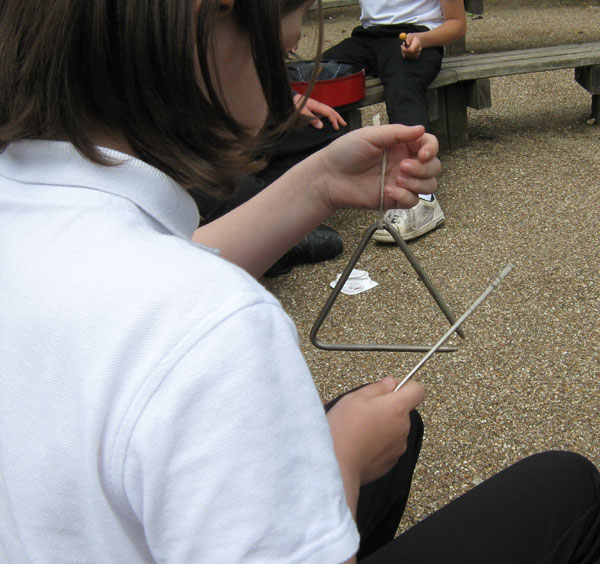
The Triangle

Whereas there are kids who will insist, on catching a glimpse of my dulcimer, that I have brought along a guitar there is no mistaking the triangle. And while 'kokiriko' is a name that is rarely remembered, 'triangle' is never forgotten.

Triangles have been used in European orchestral music since the 18th century. Like any instrument it is difficult to play well, in spite of its simple appearance. It is now used in popular music, too, and is very much a part of the Latin percussion collection. Good quality instruments are made of carbon steel but school instruments tend to be made of stainless steel. Probably the finest triangle I have ever come across was made of hammered brass. It was at one of Michael Deason Barrow's Tonalis workshops and was just one of a truly wonderful collection of instruments.

In orchestral situations tone is everything and the triangle must be suspended by a piece of string to prevent damping. To stop the instrument from spinning when hit with the beater, this piece of string needs to be an inch or so long (2.4cm). Tying a short length of string between the handles of a large bulldog clip will provide a secure mounting for the triangle as well as a way of holding the instrument. The clip can be held in the hand or attached to a stand. A metal beater is used to strike the side opposite the open corner.

The application in Latin music is much more rhythmic, the tone being secondary. A larger triangle is used and it is suspended over the index finger of the hand you don't write with. This hand is used to allow or damp the sound as required by the rhythm being played by the other hand. Damping is achieved by simply gripping the instrument with the rest of the holding hand; this has the effect of stopping the metal from vibrating.

Children are frequently underwhelmed when presented with instrument, looking wistfully at whatever has been given to their peers on either side. However, a quick demonstration of the damping technique will give them something to think about. They should master Pattern A without too much trouble. If you really want to impress them, master Pattern B and play it at speed. My own triangle seems to have been confused with a school collection so, for the time being at least, you must make do with the dots. When I either reclaim or replace the missing instrument I will post an audio demo.

As it is not a great expense you might like to buy a variety of sizes. An 8" instrument will cost you less than than £5 (pounds sterling) and a 4" less than £3.

Tuesday, 6 April 2010

The dulcimer

This steel-strung dulcimer has to be one of the most popular instruments I have ever taken into a school. It's a sure-fire hit with both children and teachers. It can be sourced from Hawkins Bazaar in the UK where they give it the less than specific name of 'music maker'. Mine says it is a zitabo and was made in China. I notice the new ones are called cymbalas and appear to come from Russia. The build specifications of the new model appear to be identical to those of my own and the writing on the box assures me that it meets European Union and American safety standards.

It really does have a beautiful sound. It is also fairly robust and the plywood sound box is unlikely to get broken. I have had two strings broken in two years of taking it to sessions. On each occasion it was when a child tried to extract too much volume. I no longer include it in the 'let's all explore the instruments at once' sessions that I still, against my better judgement, find myself involved in from time to time. Fortunately it comes with two spare strings. After that I am confident that guitar strings could be pressed into service.

Along with the spare strings, there are two plectrums (or plectra if you prefer), some rubber feet and, most importantly, a tuning key. I have never stuck on the rubber feet and this means I can teach the children about the damping or enhancing effects of playing the instrument on different surfaces. The tuning fork allows the instrument to be tuned to suit the occasion. Mine is tuned to E Major but many other scales suit it very well. I particularly like a pentatonic scale that, in Norfolk at least, passes for Japanese. This goes EFABCE.

Actually, the tuning on mine is wayward having just had two strings replaced as well as a hammering from various workshops. Tuning is a challenge as a very slight tweak with the key will make a great difference to the pitch. The new strings, one of which broke unexpectedly, keep slipping but this is probably to be expected. All the guitarists I know suffer from this problem when they change their strings. But it has a wonderful tone and natural reverb and it is these that make it a winner.

Finally there is some sheet music, written like none other I have ever seen, and some tuning tips and re-stringing instructions.

At just under £20 (pounds sterling) it is exceptionally good value. I have no idea what sort of working conditions are enjoyed by the people who make these instruments but console myself with the knowledge that they must be better off than the poor folk working in the firework factory down the street.

&<span class="blsp-spelling-error" id="SPELLING_ERROR_4">lt</span>;a <span class="blsp-spelling-error" id="SPELLING_ERROR_5">href</span>="http://miraclemen.bandcamp.com/track/dulcimer-demo">Dulcimer demo by The Miracle Men&<span class="blsp-spelling-error" id="SPELLING_ERROR_6">lt</span>;/a>

Thursday, 1 April 2010

April's free music game

This month's featured free music game is called Duets. It's a good way introducing a collection instruments to a large group in a short space of time. It works even better with a smaller group and a longer time frame but the point is that it does work with a large group. And it works well. I have found it a very useful ingredient when running taster sessions.

Tuesday, 23 March 2010

The Baritone Saxophone

A student of mine has just lent me a baritone sax and I got it out today for the first time to have a blow. The case is the size of a small car and I can't see myself peddling around with this beast under my arm like I did with the tenor. It takes up a deal of space and I can appreciate why its owner, who had another one at home, was so happy for me to take it off his hands for a while. The fruit in the picture was to give a sense of scale but I got carried away with the theme and so it's 'Still Life with Saxophone' in tribute to Tom Robbins.

This sax inevitably made me think of other big saxophones. I have come across three memorable bass saxes in my time. The first was played by Rodney Slater of the Bonzo Dog Band but I had no idea what it was when I saw them on the telly. The next was at a party in an enormous house in Hampstead Heath. There was a nine-piece Dixieland jazz band in one of the reception rooms and they found it impossible to resist the wine - plentiful and free-flowing - that the host had provided for his guests. I got talking to the player of a magnificent bass sax and discovered he was drunk enough to let me have a go (but sober enough to insist I kept in on the stand while I played).

The third bass sax that made a big impression was in a novel by Josef Škvorecký. Set in Czechoslovakia during and after the Second World War it concerns itself with the efforts of the instrument's player to keep the thing alive but hidden. Neither the Nazis nor the Soviets were big on jazz, believing it to be a symptom of a degenerate Jewish/Capitalist mind-set. In the introduction to 'The Bass Saxophone' Škvorecký recounts a list of rules drawn up by a German Gauleiter and binding on all dance bands. I have written them out in full so you can see which ones you agree with:

1 Pieces in foxtrot rhythm (so-called swing) are not to exceed 20% of the repertoires of light orchestras and dance bands;

2 in this so-called jazz type repertoire, preference is to be given to compositions in a major key and to lyrics expressing joy in life rather than Jewishly gloomy lyrics;

3 as to tempo, preference is also to be given to brisk compositions over slow ones (so-called blues); however, the pace must not exceed a certain degree of allegro, commensurate with the Aryan sense of discipline and moderation. On no account will Negro excesses in tempo (so-called hot jazz) or in solo performances (so-called breaks) be tolerated;

4 so-called jazz compositions may contain at most 10% syncopation; the remainder must consist of a natural legato movement devoid of the hysterical rhythmic reverses characteristic of the music of the barbarian races and conducive to dark instincts alien to the German people (so-called riffs);

5
strictly prohibited is the use of instruments alien to the German spirit (so-called cow-bells, flexatone, brushes, etc.) as well as all mutes which turn the noble sound of wind and brass instruments into a Jewish-Freemasonic yowl (so-called wa-was, hat etc.);

6 also prohibited are so-called drum breaks longer than half a bar in four-quarter beat (except in stylized military marches);

7 the double bass must be played solely with the bow in so-called jazz compositions;

8 plucking the strings is prohibited, since it is damaging to the instrument and detrimental to Aryan musicality; if a so-called pizzicato effect is absolutely desirable for the character of the composition, strict care must be taken lest the string be allowed to patter on the sordine, which is henceforth forbidden;

9 musicians are likewise forbidden to make vocal improvisation (so-called scat);

10 all light orchestras and dance bands are advised to restrict the use of saxophones of all keys and to substitute for them the violoncello, the viola or possibly a suitable folk instrument

To get the full flavour of times you really need to read Škvorecký's book but the above is a reminder of how lucky we are in the freedoms we enjoy. Or how unlucky we are to live in such undisciplined times. Take your pick.

Wednesday, 17 March 2010

Whatever it takes

I was discussing a music-making project that aims to involve children and young adults who may be described as being on the fringes of society. It was taken, almost as a given, that the emphasis would be on 'popular' music because it is so much more accessible. We accepted that classical music, although wonderful in itself, was unlikely to be the best starting point. It is not impossible to interest children, especially the very young, in the great composers of orchestral music but their initial interest is more likely to be fired by something more familiar.

I found myself thinking back to my own early exposure to classical music. My father had an old record player in a cabinet, most of which was taken up with the single speaker. It was a piece of furniture styled in the manner of the first televisions - a small sideboard that could be closed when not in use, it's inner workings becoming invisible. On this we could play 78s (Tubby the Tuba) and Long Players. It had a 16 rpm setting as well. The fact that we had no 16 rpm records did not deter me from playing discs at that speed. I don't remember it having a 45 rpm setting - the only 7" vinyl in the house played at 33 rpm. (It was Paul Robeson singing 'Old Man River' - painfully slow and I preferred it at 78. I only once gave it the 16 treatment but didn't have the patience to see it through to the end.)

Possibly the best purchase my father ever made was the Readers' Digest 'Festival of Light Classical Music', a 12 album boxed set. This introduced me to Tchaikovsky, Bizet, Borodin, Mendelssohn, Elgar, Verdi etcetera, etcetera. At the time I was unconcerned by the quality of sound reproduction which must have been dreadful. I had never been to a live concert and the piano we had once owned was never played so I had nothing to compare it to. No doubt a purist would have taken issue with the validity of my experience but for me it was sufficient to inspire a life in music.

Fast forward four decades or so and I am teaching a child of twelve to play Beethoven's Ode to Joy on the clarinet.
"You might recognise this," I tell him. "It's the anthem of the European Union."
(Actually, in Britain at least, that appears to be a little-known fact.) He begins to play and tells me he does indeed recognise the tune.
"It's my dad's ringtone."

I confess I felt somewhat put out by this revelation. Back in the 1970s one of my favourite actors, one Terry Thomas, destroyed my enjoyment of a piece from The Nutcracker Suite by singing a lyric in praise of Cadbury's Fruit and Nut (chocolate). [The link is to a Frank Muir version.] Much worse has happened since and listening to a cheap and synthetic rendering of Mussorgsky's Promenade when put on hold is right down there with old TT. Yes, I could have condemned this outrageous misappropriation of one of the greatest tunes of the 19th century. But I didn't.

Just as my first introduction to great music came through an old box that would have horrified the composers whose music it approximated; just as my first hearing of Pictures at an Exhibition (to which Promenade forms the introduction) came via Emerson Lake and Palmer; so there is no telling what will inspire the children of today to listen to great music and seek its source. The fact that Ode to Joy still sounds memorable as a ringtone is testament to its enduring quality. Maybe Terry Thomas inspired some great musicians to become what they are today (maybe...) and it is finally time to forgive, nay to praise, him.

Saturday, 13 March 2010

Music - the universal language

I remember, aged about ten, hearing my father rail against the tuneless racket emanating from my teenage brother's bedroom. Personally I like Bob Dylan but I do have some sympathy for my father's point of view. The guitar playing is tuneful enough but the vocal style, like English ale, is an acquired taste. And Dylan's harmonica playing is worth a post of its own, if not a whole book.

People say we turn into our parents. At sixteen I would have dismissed that suggestion out of hand but as I get older I am at least reminded of my father by parallel situations. He had three sons, I have three daughters. He had Dylan, ELP and The Beatles coming out of three different rooms to create some kind of sonic porridge in the hall. He couldn't have identified any of the constituent parts of this din, partly because it was all too alien to him but mostly because he had no interest in learning our language(s).

Strangely enough, and disappointingly really, I find the music my children play highly accessible. (Maybe that's because girls use clothes, more than music, to explore and express their identities.) I followed developments in music reasonably closely into the early 90s and have maintained an interest in more esoteric sounds since then. The music my children play often sounds like an aural equivalent of a DIY pizza; the combinations occasionally surprise and delight but the ingredients are very familiar.

What reminds me of my father, however, is not recorded music from all quarters mixed with occasional acoustic piano. It's not even the bleep, bleep, bang, whizz of computer games. None of this is remotely anarchic or threatens to shake the foundations of my 20th century value system. In fact it's all rather bland in a way that Jimi Hendrix certainly wasn't back in 1969.

No, what I struggle with is the requirement to attribute non-musical meanings to the sounds I hear. For most of my life a telephone either rang like a bell or trilled like mutant cricket. Alarm clocks were much the same, although there were also those that would switch on the radio or make luke-warm tea. Now, when I hear a piece of music, I have decide between:
  • the radio has just been switched on
  • a game is being played on the wii
  • a text has been sent to an unknown recipient
  • it is time for one of my children to wake up
  • a phone is ringing

And that last one is the worst. Like many, I find it hard to ignore a telephone unless it belongs to someone else. I am not a willing convert to the mobile phone but since acquiring one my children, from time to time, decide I should change my ring-tone. I'm sure this is done to protect me from sounding un-cool and I am suitably grateful. However, my gratitude is tempered by irritation at their failure to notify me of these updates.

So have we arrived at some kind of Tower of Babel where sounds fly around whose meaning is known only to their makers? Or is it, as I suspect, that I am turning into a grumpy old man unwilling to learn these new languages? If music really is the universal language it has certainly been misappropriated, in my humble opinion, and that, along with Dylan's harmonica playing, is the subject of a future post.